
Get Your Financial House in Order Before Halloween As the leaves change color and the…
Use Your Home Equity Without Giving Up Your Low Mortgage Rate

You may have a mortgage rate you want to keep and equity that could help you accomplish something important: pay off expensive debt, renovate your home, buy an investment property, or cover a major expense.
Does accessing that equity require you to replace your mortgage?
It doesn’t have to. A home equity loan or line of credit may let you borrow while keeping your existing first mortgage and its rate. The right choice depends on your goal, the cost, and your repayment plan.
🏠 A low mortgage rate doesn’t tell the whole story
Cotality’s Q2 2026 data show $11.5 trillion in tappable home equity nationwide. Average equity per homeowner with a mortgage was about $310,000 nationally, compared with $623,000 in California.[2]
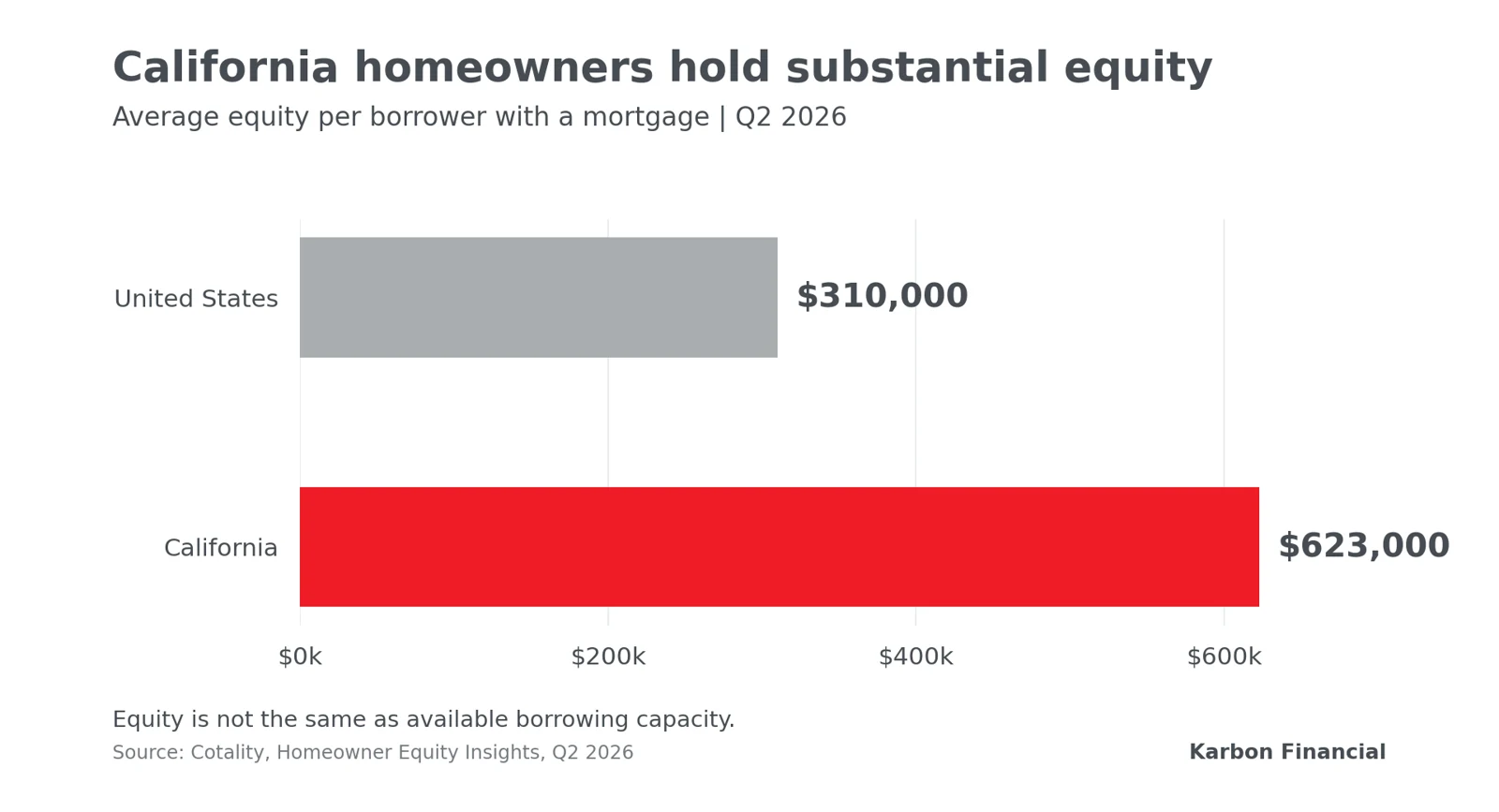
Source: Cotality, Q2 2026. Equity is not the same as available borrowing capacity.
Total equity is your property’s value minus the debt against it. Tappable equity is the portion that may be available to borrow while retaining the equity lenders require. Neither average tells you what you can borrow.
Many homeowners with substantial equity have strong cash flow and no reason to take on debt. Others may have a low-rate mortgage alongside expensive credit cards or a specific need for funds.
New York Fed research shows new credit card delinquencies remain elevated, though their pace has largely stabilized since 2024.[1] That’s useful context, but your decision should start with your own finances.
💳 Consolidating debt: relief needs a repayment plan
Using equity to pay off higher-cost debt may simplify your payments and improve monthly cash flow. But a smaller payment isn’t automatically a better deal.
Extending repayment can lower your monthly payment while increasing your total cost. Fees and potential rate changes also matter.
Before recommending consolidation, we’d compare:
- Your current balances, rates, payments, and remaining repayment periods.
- The new loan’s payment, fees, and cost over a realistic payoff timeline.
- Your plan to avoid building new balances on the paid-off cards.
Consolidation moves debt. Your repayment plan is what eliminates it.
Paying off unsecured credit cards with home equity financing also changes the risk: your home becomes collateral. If you can’t repay, you could lose it through foreclosure.[3]
A personal loan, balance transfer, or nonprofit credit counseling may be a better fit. The goal is a workable solution.
🔧 Other ways your equity may help
Renovations and repairs
Equity may fund necessary repairs, a remodel, accessibility improvements, or an addition that makes staying in your home more practical.
Start with a project budget, a contingency for unexpected costs, and an affordable payment plan. Don’t assume every dollar spent will return as resale value.
Property purchases and other investments
Some borrowers use equity for a rental property purchase, rental improvements, or a business investment, subject to the program’s permitted uses.
Borrowing costs are an obligation. Investment returns aren’t guaranteed.
We’d review the payments on both properties, cash reserves, and what happens if repairs cost more or a rental sits vacant. Borrowing against your home adds risk to your household and to the investment.
Major expenses
Medical bills, education costs, and other substantial expenses may also prompt an equity conversation.
Borrowing should address a defined need and be supported by a realistic payoff plan. Using equity to cover an ongoing gap between income and spending calls for fixing that gap first.
💡 How to access home equity without refinancing
A cash-out refinance replaces your existing mortgage with a larger one, changing the terms on your entire first-mortgage balance.
Two alternatives may leave that loan in place:
| Option | How it works | What to consider |
|---|---|---|
| Home equity loan or HELOAN | Receive a lump sum and repay it over a set term. Many have fixed rates. | May suit a defined expense or debt payoff. Compare payments, fees, and total cost. |
| Home equity line of credit or HELOC | Draw funds as needed within the line’s terms. | May suit expenses paid in stages. Many have variable rates; payments can rise as rates change or repayment begins. |
The additional borrowing has its own rate, payment, and fees. Keeping your first mortgage doesn’t mean the second loan gets that same rate.
A second mortgage priced above your first mortgage could still cost less than the credit card debt it replaces. That alone doesn’t establish savings; repayment time and fees still matter.
We’d compare the combined payments and costs against the alternatives. A cash-out refinance remains worth considering when the overall numbers support it.
📋 Self-employed or investing? Other qualification options exist
Bank statement programs
Certain lenders offer home equity financing using eligible personal or business bank statements to calculate income for self-employed borrowers. This may help when tax returns don’t fully reflect business cash flow.
Deposits aren’t automatically income. Lenders evaluate them and account for business expenses.
DSCR programs for investment properties
Debt Service Coverage Ratio financing evaluates rental income relative to a property’s debt obligations rather than relying on personal income in the usual way.
Certain lenders offer DSCR second mortgages, allowing eligible investors to access rental-property equity while keeping the first mortgage.
DSCR applies to eligible investment properties, not your owner-occupied home. These are business-purpose programs with proceeds restricted to permitted business or investment uses.
Both paths have credit, equity, property, and other requirements. Availability and terms vary by lender.
✅ Start with what you want to accomplish
At Karbon Financial, we have access to more than 100 wholesale lenders. We help you compare financing options and understand the tradeoffs.
Sometimes keeping your first mortgage makes sense. Sometimes refinancing is a better fit. Sometimes the right move is to leave your equity alone.
To get started, gather your estimated property value, mortgage balance and rate, how much you need, and what you want to accomplish. For consolidation, include the debt balances and payments you’d like to replace.
Let’s look at the numbers and see what makes sense for you.
Compare Your Home Equity Options
Financing is subject to lender guidelines and credit approval. This is not a commitment to lend. Your property secures home equity financing. Consult a tax professional; do not assume interest is deductible.

Related Posts